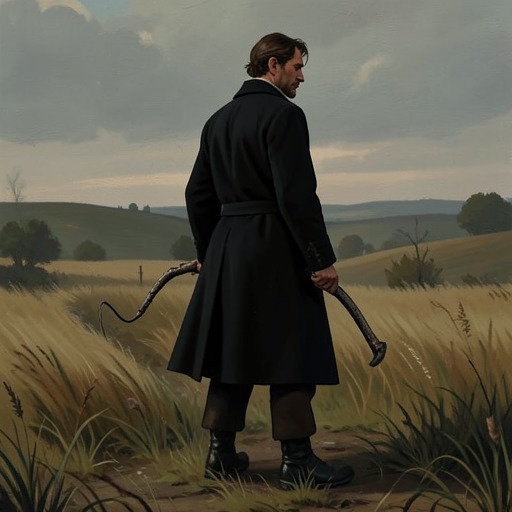
Gilbert Markham—Mr. Lawrence friendship
The Tenant of Wildfell HallGilbert Markham—Mr. Lawrence friendship is a limited but consequential intimacy between neighbors whose companionship depends on Gilbert’s openness and Mr. Lawrence’s reserve. Gilbert describes their early connection as a mutual liking rather than a deep friendship; when suspicion and wounded feeling intervene, the relationship becomes a source of conflict. Its narrative importance extends beyond the two men: Gilbert’s account to Halford and his reading of Helen Graham’s manuscript make the friendship part of the frame through which the reader encounters Helen’s history.
Identity and Early Companionship
Mr. Lawrence is the young squire whose family formerly occupied Wildfell Hall before moving, about fifteen years earlier, to a more modern house in the neighboring parish. Gilbert and Lawrence are on tolerably intimate terms, although Lawrence’s secluded habits and reluctance to leave the place where he was born restrict his circle of acquaintances. Gilbert considers himself the companion Lawrence most enjoys among those he has known, but the qualification matters: their bond is formed within Lawrence’s narrow social world rather than through broad, easy sociability.
Gilbert likes Lawrence but does not feel the warmth of a solid, deep friendship. He admires Lawrence’s courtesy and recognizes that he values candor and frankness in others, yet Lawrence cannot readily express those qualities himself. Gilbert interprets his friend’s reserve not simply as pride or distrust, but as a sensitivity and diffidence Lawrence seems unable to overcome. He compares Lawrence’s heart to a plant that opens briefly in sunshine and closes at the slightest touch. The image captures both the attraction and the difficulty of the relationship: Lawrence is responsive to company, but intimacy remains precarious.
Suspicion and Rupture
The friendship is tested when Gilbert, having seen Lawrence approach along the hilltop lane, goes out of his way to speak with him. Gilbert asks directly whether Lawrence is in love with Helen Graham. The question exposes Gilbert’s own anxiety about Helen and places Lawrence, whose private life is usually guarded, under suspicion. The available evidence establishes the question and the strained encounter, not a settled romantic relationship between Lawrence and Helen.
Later, Lawrence asks Gilbert what is troubling him. Gilbert responds with hostility rather than explanation. Lawrence calmly warns that if Gilbert has designs on Helen, they will fail, and says he is sorry to see him entertaining false hopes. Gilbert calls him a hypocrite. Lawrence is visibly affected and leaves without continuing the argument; Gilbert acknowledges that his words have wounded him and admits that he is glad. The exchange turns a cautious friendship into an immediate personal breach: Lawrence attempts to warn Gilbert, but his unexplained knowledge and controlled manner make the warning seem to Gilbert like hypocrisy.
The Manuscript and the Frame Narrative
The later account of the friendship is embedded in Gilbert’s retrospective narration to Halford. At the close of an instalment, Gilbert presents his letter as the first portion of a debt to his correspondent and offers to send the rest if Halford wants it. This frame makes the friendship with Lawrence part of a larger structure of disclosure: Gilbert is not simply recounting events but deciding what to transmit, in what sequence, to a trusted reader.
A crucial change in that transmission occurs when Helen gives Gilbert a thick manuscript, tears away a few leaves from its end, and asks him to read it and keep its contents secret. She later calls him back to repeat the request that he return it and tell no one what it reveals. Gilbert reads the document first rapidly, then through in full; he tells Halford that he still has it and will provide its contents rather than an abbreviation. The friendship between Gilbert and Lawrence therefore sits beside, and is partly overtaken by, a different trust: Helen entrusts her written history to Gilbert, who then mediates it for Halford and the reader.
The manuscript’s surviving end is visibly incomplete. Gilbert reaches a passage beginning to describe the parish’s young gentleman and beau, but the rest has been torn away. He assumes Helen was about to mention him, while recognizing that the missing description may not have been favorable. That assumption reveals the limits of his interpretation: just as he had read Lawrence’s reserve suspiciously, he reads Helen’s fragment through his own hopes and recollection of her manner toward him.
Significance and Limits
The relationship is defined as much by asymmetry as by affection. Gilbert is frank and quick to act on his feelings; Lawrence is private, cautious, and difficult to read. Their clash shows how reserve can invite suspicion, while Gilbert’s own admission that he meant to hurt Lawrence makes clear that misunderstanding is not the only cause of their estrangement. In this episode, Gilbert chooses retaliation over the patience and candor he claims to value.
The friendship also helps expose the limits of Gilbert’s narrative authority. He recounts his own jealous question, hostile response, and later reading of Helen’s manuscript to Halford, but he cannot restore the missing leaves or verify what Helen would have written about him. Lawrence’s warning is filtered through Gilbert’s anger, and Helen’s story reaches the outer narrative through a document Gilbert selects and relays. The bond between the two men thus contributes to the novel’s layered presentation of knowledge: private lives are known indirectly, through guarded conversation, remembered conflict, and written testimony that may itself be incomplete.